MOM, MES and AGV, the layer that turns a collection of machines into a plant that can be measured, traced and improved.
We follow the ISA-95 reference model, so responsibilities are cleanly separated and integration with your existing ERP, or with a third-party MES you already run, is a defined interface rather than a custom project.
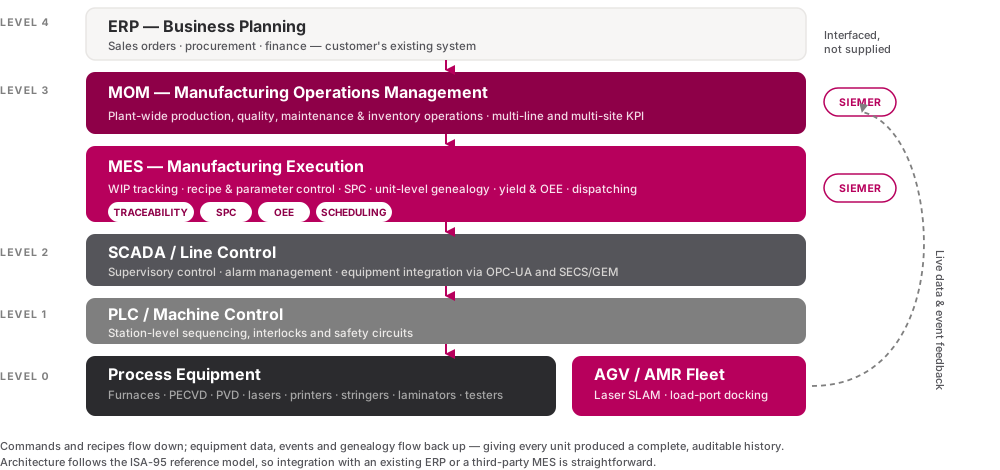
MOM sits above MES and manages operations as a whole rather than execution on a single line. It is where multi-line and multi-site questions get answered.
Order orchestration across lines, capacity allocation and production planning against demand.
Specification management, non-conformance workflow, corrective action tracking and audit readiness.
Planned and condition-based maintenance, spare parts management, equipment history.
Material and WIP visibility across the plant, consumption tracking and reconciliation.
MES runs the line: it dispatches work, enforces the process, captures what happened and makes the result analysable. Everything downstream in quality and cost analysis depends on the completeness of this capture.
Real-time work-in-progress position by station, lot and unit across the whole line.
Controlled process parameters downloaded to equipment, with change management and version history.
Full traceability from wafer or cell through to finished, serialised product.
Inline metrology feeding SPC charts with automatic out-of-control alerting.
Yield by station, defect Pareto and loss attribution to specific equipment or parameters.
Overall equipment effectiveness with availability, performance and quality decomposition.
Work order dispatch with material availability and equipment state awareness.
Consolidated alarm handling with escalation paths and response tracking.
Labour, material and overhead allocated by batch, product and customer for real cost visibility.
Unit-level genealogy depends on identity being readable at every transfer point and on equipment being able to report what it did. Both are specification decisions made when the line is designed. Retrofitting traceability onto a line that was not built for it typically yields partial data with gaps exactly where investigations need it most.
Automated transport replaces the trolleys, and with them the handling damage, the queueing at load ports and the gaps in the traceability record. Two vehicle classes do this job and they are not interchangeable. Choosing between them per route is part of the layout work, not a purchasing decision taken afterwards.
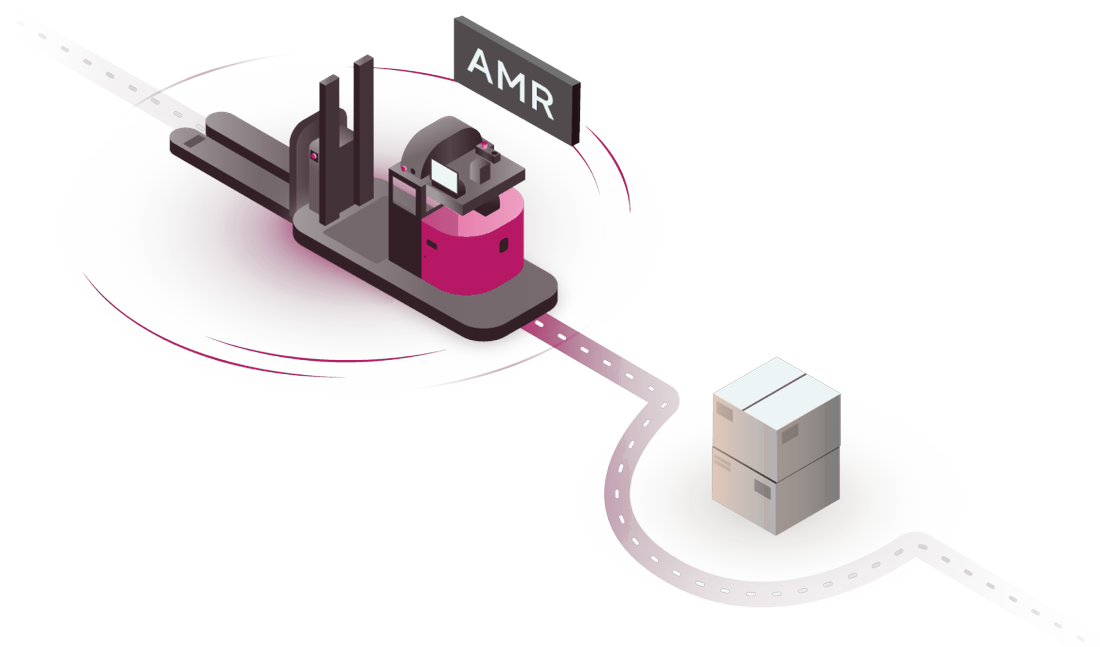
Carries its own map. It localises by laser scan against the building it can see, so a route is a piece of software rather than a piece of floor. Meeting the pallet above, it plans around it and carries on, which is what makes it usable in aisles shared with people and forklifts.
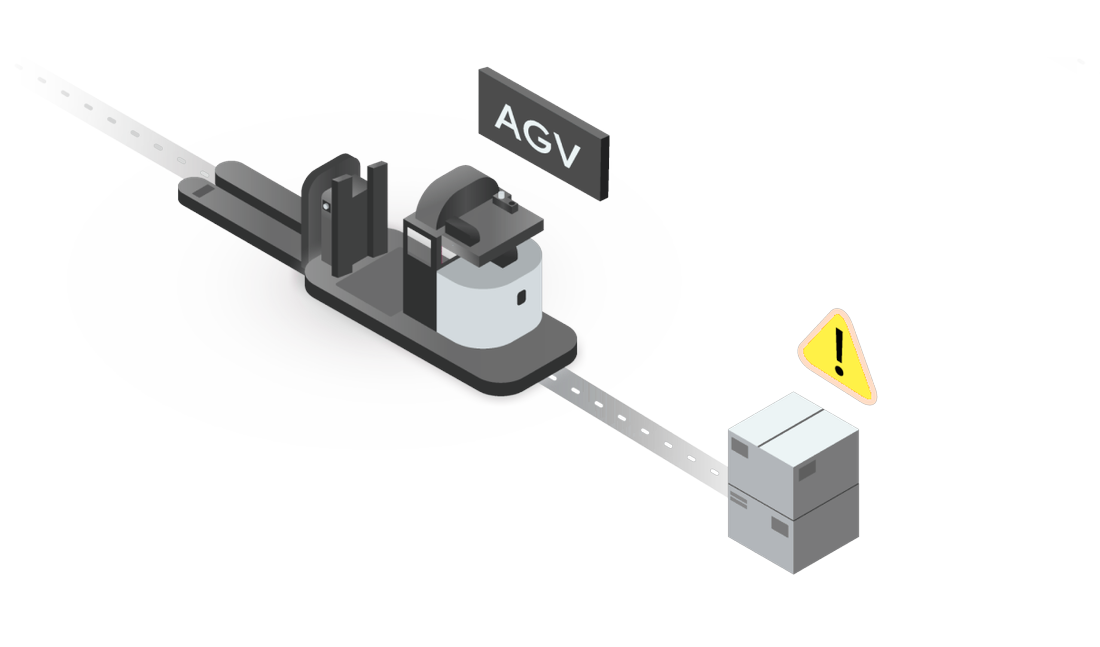
Follows a path laid into the floor, as magnetic tape, inductive wire or markers. It cannot leave that path, so the pallet above stops it and raises an alarm. On a trunk route that will run unchanged for years, that constraint buys higher payload, a simpler fleet and a lower cost per vehicle.
| AGV — guided | AMR — autonomous | |
|---|---|---|
| How it navigates | Follows a fixed path: magnetic tape, inductive wire, or floor markers | Builds and localises against its own map using laser SLAM |
| Changing a route | Physical work. The guide path is re-laid and the floor re-commissioned | A software change. The map is edited and the fleet redeployed |
| Meeting an obstacle | Stops and waits. It cannot leave the path | Plans around it and continues, if the aisle allows |
| Best suited to | High-volume fixed routes that will not move for years | Mixed routes, shared aisles, and layouts still expected to change |
| Relative cost per vehicle | Lower, with cost in the floor infrastructure | Higher per unit, with no floor infrastructure |
| Where we use it | Long trunk routes between process areas, and cassette loops that mirror the process flow | Feeding stations that get reconfigured, and any area shared with people and forklifts |
Transport is designed with the line, at the same time as the equipment layout. Retrofitting it into a plant that was laid out without it is where most of the cost and disappointment comes from.
Transport routes, passing places and buffer positions drawn at layout stage, so vehicles are not squeezed into whatever floor the equipment left behind.
Vehicle count derived from takt time, route length, dwell at load ports and charging strategy, rather than estimated and corrected later.
Docking positions and tolerances specified with the equipment vendors, so loaders and unloaders are ordered AGV-ready instead of modified on site.
Fleet management for routing, right of way at junctions, opportunity charging and a battery strategy that holds availability across all shifts.
Certified 360° laser scanners, zone speed limits, floor markings and interlocks with equipment doors, designed to the plant's safety assessment.
Every move dispatched by, and reported back to, the MES layer, so material movement forms part of the genealogy rather than a blind spot in it.
A vehicle can reach a machine and still not be able to hand material to it. Load-port height, docking tolerance, handshake signals and the cassette or tray standard all have to be agreed across every equipment vendor on the line. Doing that during specification costs a series of conversations. Doing it after delivery costs mechanical rework on machines that are already installed and commissioned.
| Component | Function | Typical interfaces |
|---|---|---|
| WMS, warehouse management | Inventory location, picking, replenishment and stock accuracy | MOM, MES, AGV fleet manager, ERP |
| Intelligent logistics (ILD) | Automated material distribution between storage and line | AGV fleet, stacker cranes, AS/RS |
| Line control / SCADA | Supervisory control, alarm consolidation, equipment coordination | OPC-UA, SECS/GEM, PLC networks |
| Equipment integration | Standardised data capture and command interface per machine | OPC-UA, SECS/GEM, EAP adapters |
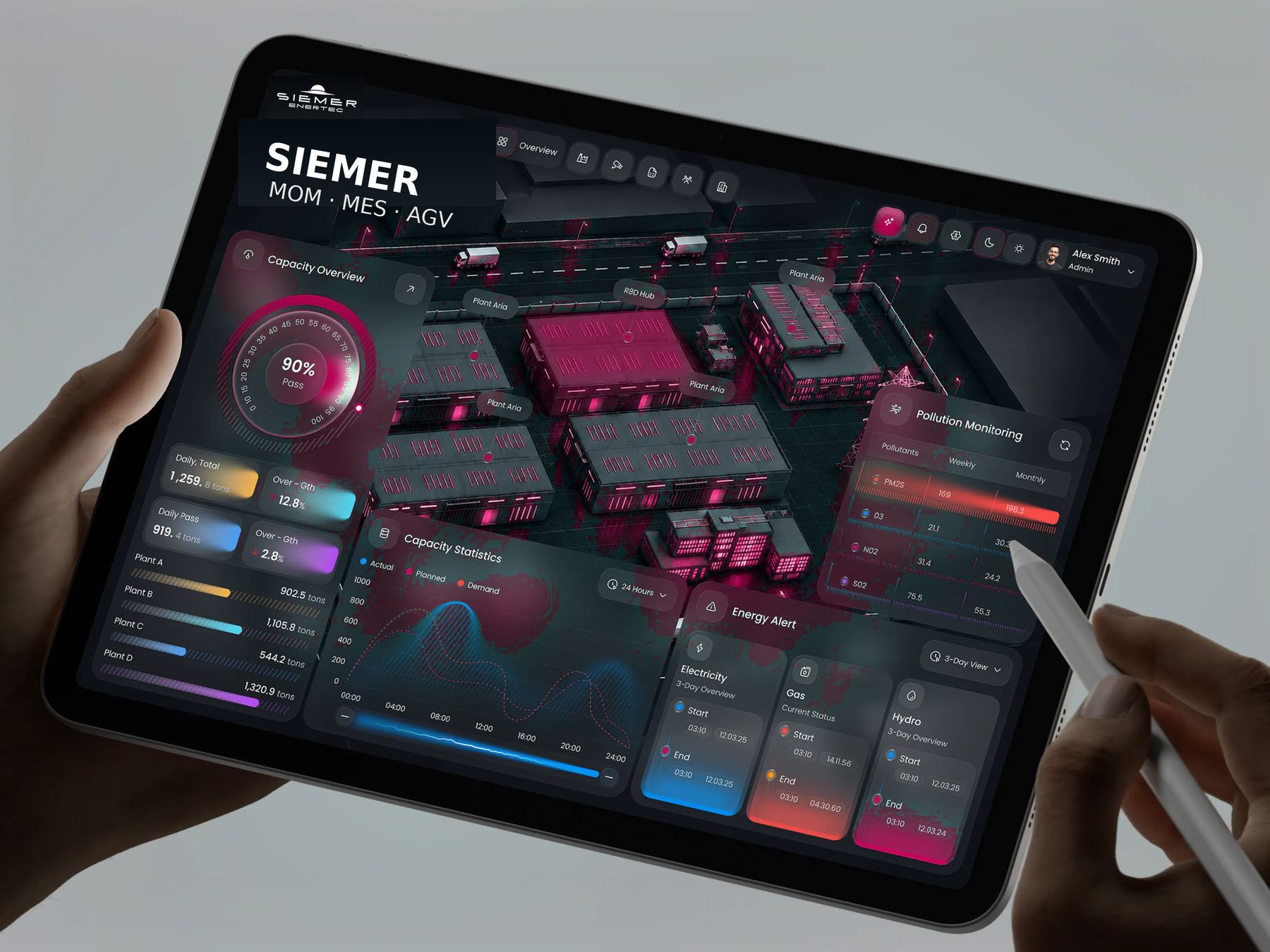
| Dashboards & reporting | Live plant status and management reporting | MOM, MES data layer |
Automation is usually justified on labour reduction, because that is the number easiest to put in a business case. It is rarely where the return ends up. The durable value is that the plant can answer questions about itself, and answer them in hours rather than after a fortnight of arguing across departments.
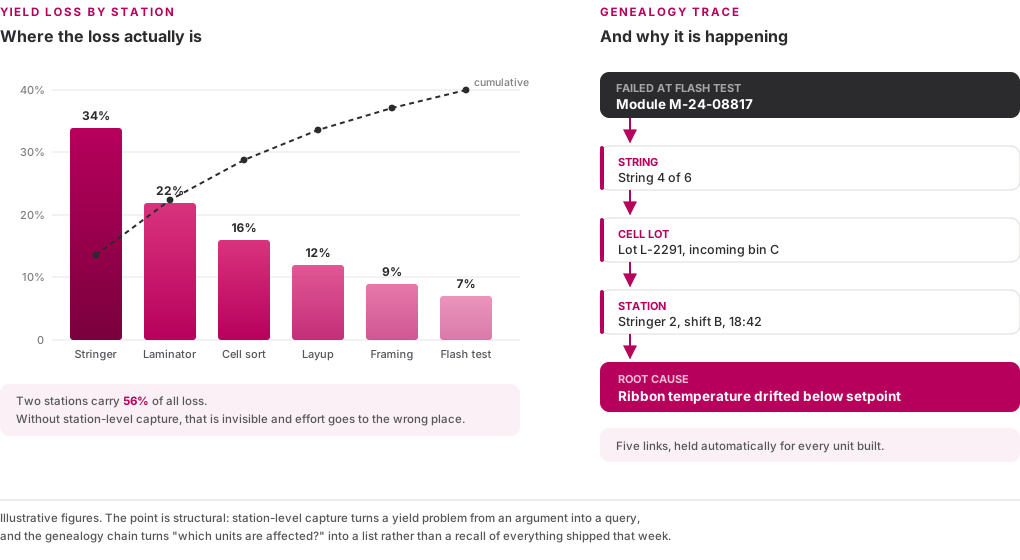
Yield is a monthly number. Nobody agrees which station causes it, because nobody measured per station. A customer complaint means quarantining everything shipped that week, because there is no way to identify which units share the suspect lot. Recipe changes live in an operator's memory.
Yield is a Pareto by station and shift. The suspect units are a query, not a quarantine. Recipes are versioned, downloaded to equipment and enforced. Cost is attributed per batch and customer, so the margin on each product is known rather than assumed.
Enforced recipes and parameters, so output does not depend on which shift ran it.
Unit-level genealogy turns a recall into a list of affected serial numbers.
SPC and yield attribution from day one, which shortens the climb to qualified yield.
Fewer manual transfers, and less of the breakage and contamination that comes with them.
Labour, material and overhead attributed per batch, product and customer.
Warranty and compliance records retained for the product's service life.
Labour saving is easy to calculate and usually the smaller figure. The larger one is what a single containment event costs when you cannot identify the affected units, or what a slow ramp costs in lost production before qualified yield is reached. Both are avoided by data captured automatically at every station, which only exists if the line was designed to capture it.
Cassette transport, wafer-level data capture and sorting integration.
View lineRecipe control, inline metrology SPC and cell-level genealogy.
View lineString-to-module traceability, EL and flash data binding.
View lineBoard-to-unit genealogy, torque and calibration records.
View lineMatched-set enforcement, weld data and formation curves.
View lineThe complete engineering scope in one view.
View solutionsWhether it is a new plant or an existing line that needs a traceability layer, we can scope the MOM, MES and AGV design with you.